“When we start to think about a person’s scientific success and journey, we forget that the scientist is a human being first. Our primary engagement should be with humanity, and we should use science for the betterment of society. In life, you cannot compartmentalize things. If someone can not commit to life it will be hard for them to have a passion for science”, said Prof.
Ashutosh Sharma, Secretary, Department of Science and Technology, Government of India.
Prof. Ashutosh Sharma
He is a visionary academician who has made some exceptional interdisciplinary contributions in the nanoscience and nanotechnology fields. He is a recipient of the prestigious Shanti Swarup Bhatnagar award in engineering sciences for his “original pioneering contribution to the understanding of the behavior of thin films and other highly confined nanoscale systems.” He has been conferred with numerous awards, but according to him awards do not define a scientist, it is his work in the field that leaves a long-lasting impression on the community.
“Science brings a larger dimension to life. My scientific journey is all intertwined with successes and failures. Success does not define one’s life and neither should failure. Both of them are transient. To live a life which we are proud of we need to understand both of them. Limited success or failure keeps on interchanging in life, but the most important thing is that you have to keep learning from both. It is a sense of curiosity, mystery, evidence-based analysis, and stamina for life-long learning that science has taught me, and all these helped me grow as a human being in life outside of science as well”.
He very firmly stated he does not like calling anyone old. He said, “Age is the linear translation in time. Someone old today was younger yesterday, and the same person was young before that. So, I just call everyone young or younger! When I was younger, I have seen many of my young peers indulge in criticism of ‘old people’, especially in positions of authority. Some of them have now switched to criticizing the young and younger folks! It is the easiest thing to criticize anyone or any institute or a policy, for it brings psychological comfort. However, one has to remember not to get caught in whimsical, impulsive criticisms. It can degenerate into becoming a vicarious substitute for your work”.
Sometimes in life when you do not get an award or a rewarding one is easily demotivated. Prof. Sharma says, “ When you don’t get an award, we quickly say that the world is unfair and terrible. Our world view undergoes a metamorphosis and we set out to blame everyone. But if we get an award, we give credit to ourselves and everything in the world seems hunky-dory. It is important to share with the younger generation that many different factors in which one does not have any control can play an important role in our successes, including awards. There could be both false negatives and positives. Why should such awards affect our passion for science or life? Awards or rewards have nothing to do with the work that we still need to do. Dedication to gain knowledge, passion to do science, acceptance of failures, developing grit in life are some of the values that we need to cultivate, and these will ultimately help one value one’s work and nothing else. Of course, as you do your work with commitment and excellence, bonuses such as promotions, recognition, etc. will likely follow. However, never let these be the focus of your life or excuses that take us away from our work”. His advice to students is not to get demotivated or demoralized because of circumstances beyond our control for leading a minimally stressed life.
Prof. Sharma received his B.Tech. in Chemical Engineering from IIT Kanpur in 1982. In 1984, he obtained his master’s from Pennsylvania State University and later obtained a Ph.D. at the State University of New York, Buffalo in 1988. After his Ph.D. , he worked as a research scientist with the Department of Ophthalmology, School of Medicine and Biomedical Sciences, State University of New York. In 1990, he moved back to India and joined IIT Kanpur as an Assistant Professor in the Department of Chemical Engineering. On his decision to move back to India he said, “As a scientist, I think it is important to identify and separate our self-centered interests from the greater good of people and organizations we serve around us. Professionally, it was not easy to move from the USA to India in the 90s owing to very different scientific ecosystems and the opportunities offered. I had decided to be a teacher in my high school years and had made up my mind to be at an IIT in my undergraduate years. Academia offered me the freedom to pursue knowledge that I desired. India offered extraordinary challenges, together with an exceptionally rich canvas and texture of life that appealed to me. I never doubted that India was the right place for me. I look at all challenges as opportunities. Be proud of your way of life and culture and of course work on what needs to be changed. Work towards a better way of life and building a thriving society in whatever role life offered us. Have the self-confidence to stick to your impartial analysis. Keep in mind all factors and decide. Decisions might be correct or wrong but be ready to be committed to all your decisions and take responsibility for them”.
Further, he said, “Basic research has to be less incremental and more profound. As scientists, we should have a risk-taking ability. Fear of failure is deeply rooted in each one of us, but we have to work to overcome this fear. Constantly keep challenging yourself. Look for new opportunities. We cannot all be Einstein but can work hard to utilize our potential to its maximum. In applied research, direction, and relevance matter. We should identify a relevant problem and not necessarily a fashionable problem to work on even though it may have risks. We need to train and make leaders, not followers. Think about new things. Much of the current research is based on tools and not on problems. The tendency is to stay in one’s comfort zone as one is aware of and master of certain techniques. We often search for the problems to fit these tools. But what also needs to be cultivated is problem-based research. Do not be afraid of your limitations but identifying them and learning more about them will help you overcome those. Keep on learning and adapting to advance your search and research”.
Prof. Sharma added, “ That this philosophy applies to life as well. Get rid of “ energy vampires” that drain you of your potential and energy. Don’t just complain about circumstances and people but keep your curiosity and yearn to learn and adapt to changing situations. You make your life. Your choices will decide the course of your life. So instead of looking at the past, what I often do is project myself in the future to understand and anticipate the direction of today. Self- awareness, and self- analysis are very important for growth and development. Things are convenient if you know them but in life, there are things you need to do. Take a route to challenge yourself rather than being confined to comfort zones. At every moment keep learning. Learn from people from different backgrounds, do not limit yourself by divisions. Amalgamate knowledge from all sources and be sympathetic to people who have different views. Empathy and capacity to learn, the curiosity of the subject is important for learning rather than focusing on the content. Develop a lifelong capacity to learn, education is a journey of synthesis of knowledge not only analysis. This is very important in life to make meaningful decisions that are not spelled out in textbooks. Choose your life, choose your goals, have control, and take responsibility. Live a fulfilling life that one can be proud of, rather than a successful life as defined by the yardstick of other people”.
Author- Dr. Arti Dumbrepatil, Science Writer/Communicator.
Co-lead and chief communicator for Program Kalpana of VigyanShaala International
Watch the full panel discussion – Indian Women in STEM Prof. Ashutosh Sharma (Secretary DST) and Prof. Shobhana Narasimhan (JNCASR)
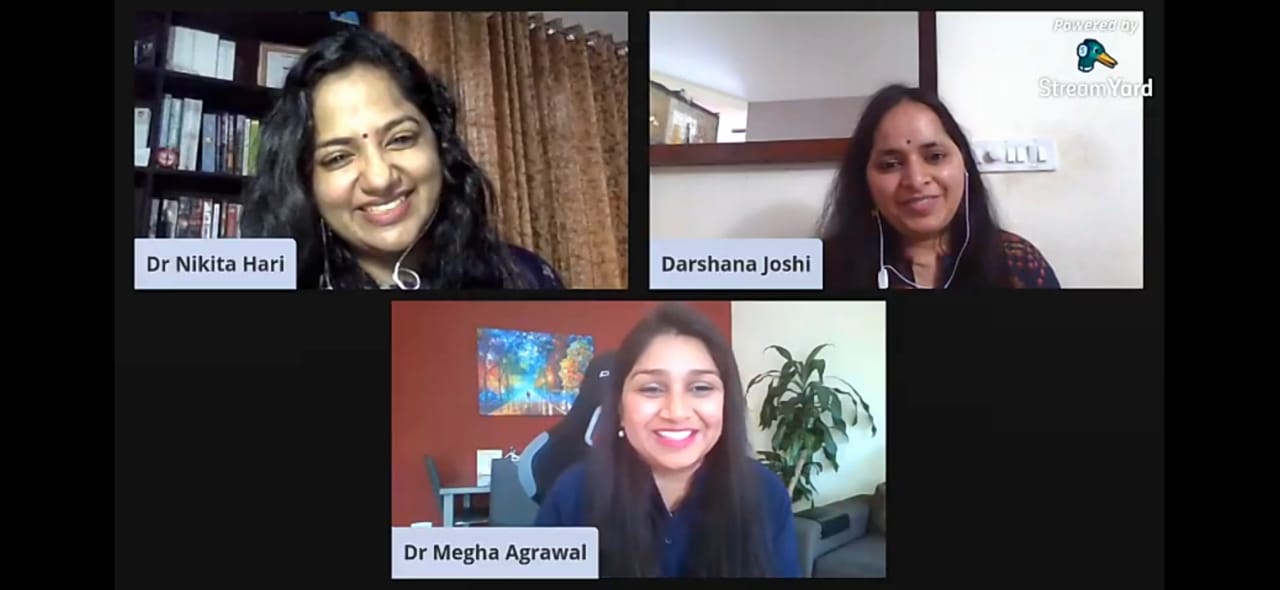

 Following Dr Megha Agrawal’s talk, Dr. Nikita Hari who already has two startups to her credit was introduced. Dr Hari started by thanking CoViD-19 warriors and mentioned that women are affected disproportionately and unjustly by Covid, but asserted that CoViD-19 has clearly highlighted that women are the working heros, especially as frontline workers. She was hopeful that now more girls would be attending and completing STEM courses in schools and colleges.
